


A Breakthrough in Urethral Stricture Treatment: Tissue Engineering Without Major Surgery

Urethral stricture—a narrowing of the tube that carries urine out of the body—has long being a source of frustration for both patients and urologists. While trade treatment exist, they often involve a direct choice between temporary fixes that file frequently or major surgeries that review long recovery times.
In a recent breakthrough discussed by Dr. Vikas Singh, a new treatment method using tissue engineering is changing the landscape, offering a high success rate out the need for major incisions.
Understanding Urethral Stricture and Common Challenges

What is a Urethral Stricture?
A urethral stricture occurs when a part of the urethra becomes scarred due to injury, infection, or previous medical procedures. This scar tissue acts like a "blockage," making it difficult and painful to pass urine, incidentally leading to bladder and kidney issues if left untreated.
Why Standard Treatments Like Dilation and DVIU Often Fail
For years, the most common "quick fixes" have:
Dilation: Stretching the narrow part of the tube.
DVIU (Direct Vision Internal Urethrotomy): Using a laser or blade to cut the scar tissue.
The problem? These methods don't remove the scar; they just move it. When you cut a scar, the body heals by creating More scar tissue, often making the strategy harder and more complex than it was before.
The Pros and Cons of Traditional Urethroplasty
Urethroplasty is currently the "gold standard" for long-term success (85–90%). It's instantly removing the scar and replacing it with a graft, usually taken from the inside of the patient's cheek (buccal mucosa). While effective, it is a major open surgeries that reverse a large incision and 2–3 weeks of living with a catheter.
The Future of Urology: How the New Tissue Engineering Kit Works
This new method aims to achieve the results of a urethroplasty but through a minimally innovative approach.

Step 1: Harvesting Buccal (Cheek) Mucosa Cells
Instead of removal a large strip of skin from your cheek, the doctor takes a tiny biopsy—roughly 5x5 mm (about the size of a pencil eraser). This causes minimal discommfort and heals very quietly.
Step 2: The 14-Day Lab Culture Process
That tiny sample is sent to a specificized laboratory. Using advanced tissue engineering, scientists extract the cells and the growth in a culture of application. 2.5 million cells Over a two-week period.
Step 3: Minimally Invasive Implantation Via Syringe
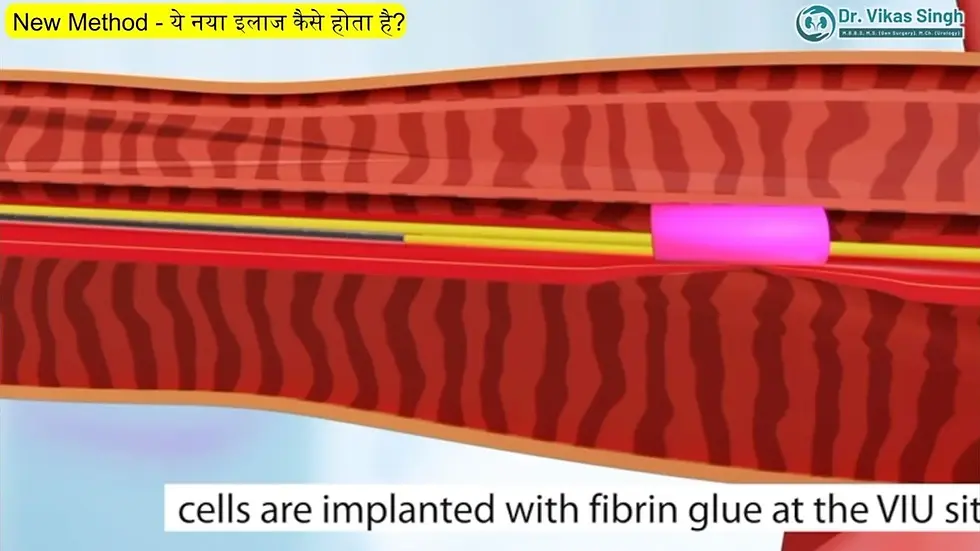
Once the cells are ready, they are sent back to the hospital. The urologist performs a standard DVIU to open the structure, but then immediately injects the engineered cells Directly into the site using a specificized syringe.
Why This "No-Incision" Method is a Game Changer
Avoiding Major Open Surgery and Long Recovery Times
Because the treatment is delivered through the natural urinary opening (endoscopically), there are no external cuts or stitches. This significally reduces post-operative pain and all these patents to return their normal lives much faster than trade surgery.
How Engineered Cells Prevent Recurrent Scarring
The secret lies in the biology. By placing healthy cheek cells onto the fresh cut, the body is encouraged to heal with "soft" mucosal tissue rather than "hard" scar tissue. These cells form a scaffold around the catheter, independently rebuilding a healthy urethral lining from the inside out.
Success Rates: What the Clinical Studies Show
Clinical data shows that this tissue engineering approach has a long-term success rate of 70% to 90%. This is a massive improvement over standard DVIU and reveals the success of the major open surgeries with out the associated risks of a large operation.
Convention: Is This New Treatment Right for You?
Medical science is moving toward a here where "major operations" become "minor procedures." For those suffering from record urethral strictures, this tissue engineering approach offers a middle ground: the long-term reliability of a graft surgeries with an endoscopic procedure.
If you are struggling with urinary blockages, consult with a urologist to see if you are a candidate for this advanced, no-incision treatment.
Frequently Asked Questions (FAQs)
Q: How is this new treatment different from a standard DVIU or laser surgery?
A: In a standard DVIU, the surgeon simply cuts the scar tissue, which often leads to the scar growing back even wider. In this new treatment, after the cut is made, lab-grown healthy cells are injected into the areas. These cells act as a "living graft," encouraging the body to heal with soft, healthy tissue instead of a new scar.
Q: How long does take the entire process?
A: The process happens in two stages. First, a tiny sample of cheek tissue is taken during a consultation. It takes time approximate 14 days for the laboratory to grow the natural 2.5 million cells. Once the cells are ready, the actual implantation procedure is a port, daycare or overnight.
Q: Is it painful to have the cheek cells harvested?
A: No. Unlike trade urethroplasty, which reverse removal a large strip of skin (several centimeters long), this method only requires a tiny 5x5 mm biopsy. This small site heals very Quickly —often within 24 to 48 hours—with minimal discommfort.
Q: What is the recovery time compared to traditional surgeries?
A: Traditional "open" surgeries a large incision and often 2–3 weeks with a catheter. Because this new method is one endoscopically (without any external cuts), the recovery is much faster. Most patients exposure significally ls pain and can return to their daily activities much sooner.
Q: Is this treatment permanent?
A: Clinical studies show a long-term success rate of 70% to 90%. While no medical procedure can guarantee 100% permanent results for every patient, this method is significally independent than trade or simple laser cutting, and it travels the success of the major open surgeries.
About the Author
Dr. Vikas Singh is a highly distinguished Consultant Urologist, Genito-Uro Oncologist, and Kidney Transplant Surgeon currently practicing at Kokilaben Dhirubhai Ambani Hospital, Indore. With over 15 years of experience and more than 10,000 surgeries perforated, Dr. Singh is recognizable as a pioneer in advanced urology. Holds the record for being the youngest surgeon in India to complete 100 individual kidney transplants and has had a central figure in anguishing revolutionary, minimally invasive treatment like UroLift And tissue engineering to Central India. A member of the American Urological Association (AUA) And the Urological Society of India (USI), Dr. Singh is dedicated to bring the latest scientific advances to his patents with precision and compassion.
Comments